FUE Donor Area Scars: Will They Show with Short Hair?
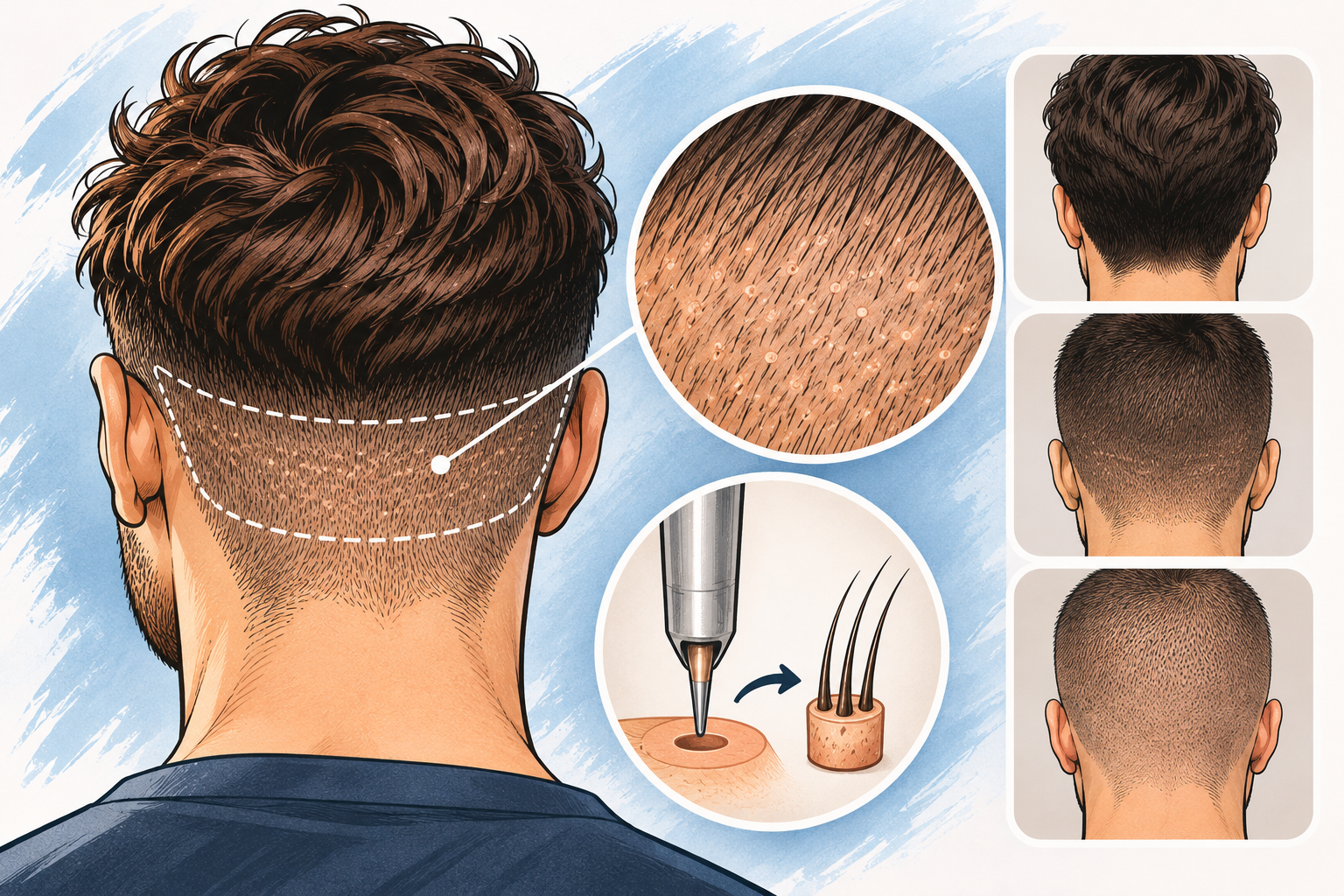
FUE donor area scars can be difficult to see under everyday hair coverage. Cut the same hair very short, though, and small marks at the back or sides may become visible. If you usually ask your barber for a skin fade or a close buzz cut, that difference matters more than whether a clinic describes its technique as leaving “minimal scarring”.
I would start the conversation with a photo of how you actually wear your hair. A photograph of someone else with longer hair may show that their donor area looks well covered at that length. It tells you very little about what a much shorter cut would reveal.
What Do FUE Donor Area Scars Look Like?
FUE removes follicular units one at a time through small circular openings. As those sites heal, they can leave tiny marks, sometimes lighter than the surrounding skin. Strip harvesting, by comparison, generally leaves a line where the strip was removed. Saying FUE avoids that line is accurate. Saying it leaves no scars is not. The International Society of Hair Restoration Surgery explains this distinction.
Immediately after surgery, the donor area may have redness and small crusts. That early appearance is not the same as the healed appearance. As the scalp settles and the surrounding hair grows, individual extraction sites may be harder to pick out. How well the area is covered is a different question from whether removed donor follicles grow back.
Why the Same Donor Area Looks Different After a Haircut
With a longer cut, the remaining hairs can lie over the skin between extraction sites. A close cut removes some of that cover. The contrast between the skin and any lighter marks also affects what you can see. There is no single clipper setting that can be promised to conceal FUE donor area scars in everyone.
It helps to distinguish small points from a broader patch that looks thin. The points are marks at individual healing sites. A patch may look less full because there is less hair left to cover it. The two can occur together, but a few visible dots do not on their own establish donor area overharvesting. And an area can look thinner even if you cannot pick out individual scars.
What to Ask Before Surgery if You Prefer a Short Cut
Bring a photo that shows the back and sides, especially if your usual cut is shorter than the one you have now. Ask to see healed donor-area photographs, not only front-facing results, and look for hair lengths close to your own. It is also worth asking how any earlier surgery or visible thinning might affect the plan.
FUE donor area scars deserve a place in the consultation even if your first concern is your hairline. If keeping the sides shaved is important to you, say so before the plan is agreed. Your usual haircut is part of the result you will live with, not a detail to bring up afterwards.